

Ministry of Justice presents legislative priorities for the spring session: greater efficiency, clarity and security
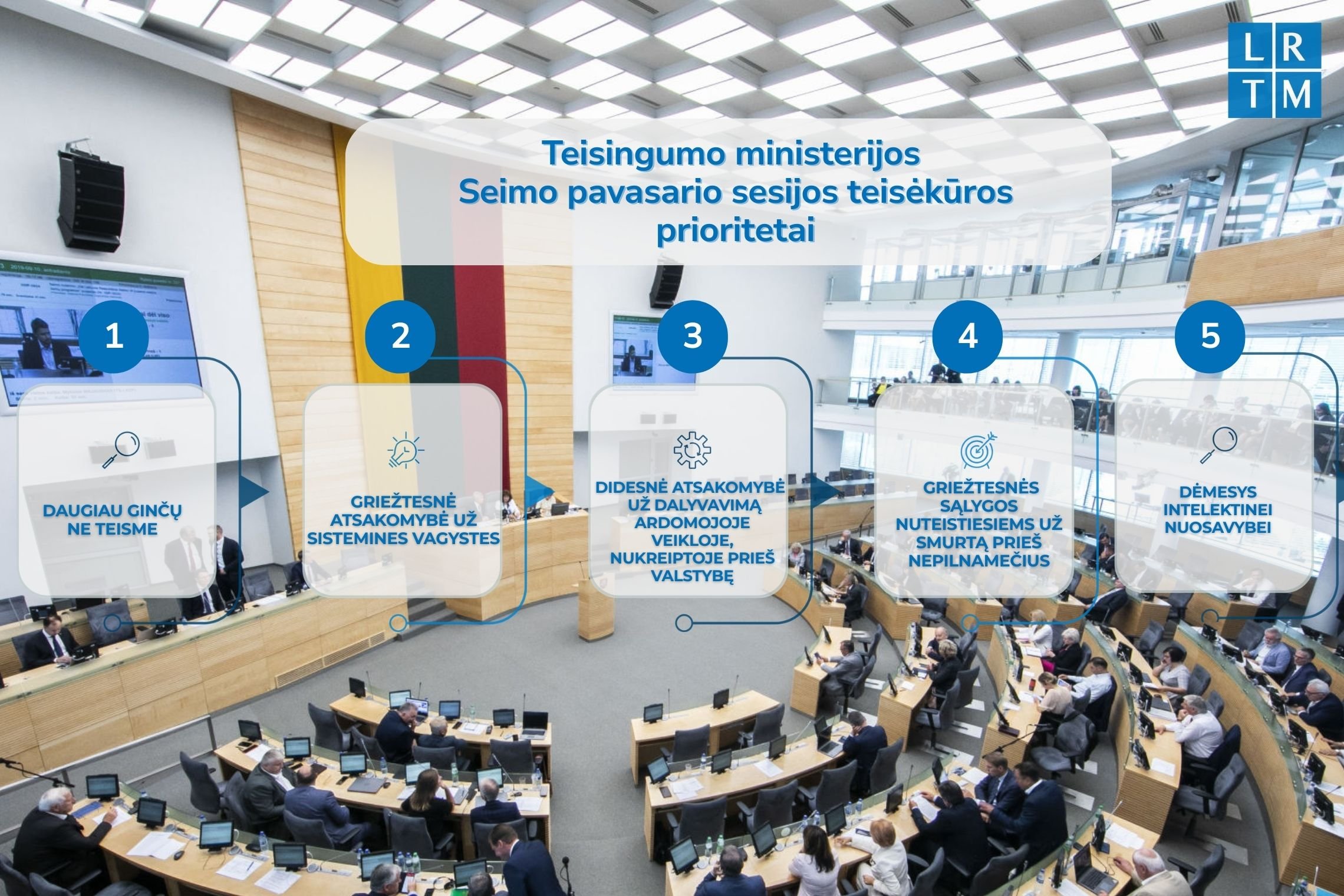
The Ministry of Justice is submitting a package of draft legislation to the Seimas for its spring session, aimed at modernising the legal framework, increasing its efficiency, and strengthening public and state security.
“The proposed changes cover various areas, from criminal law to intellectual property protection. Our goal is a more efficient, clearer legal system that better meets the expectations of people,” noted Minister of Justice Rita Tamašunienė.
More disputes out of court
One of the most important proposals is to expand the mandatory pre-litigation procedure for hearing administrative disputes. It is foreseen to establish additional dispute categories to be first of all handled out of court. This would help reduce the workload of administrative courts and shorten the duration of proceedings.
It is also proposed that complaints be examined according to the applicant's place of residence or registered office, thus distributing the workload more evenly among the territorial divisions of the Lithuanian Administrative Disputes Commission.
At the same time, it is planned to extend the time limits for appealing against administrative and court decisions in order to ensure more effective remedies for individuals.
Stricter liability for systematic petty thefts
In response to the increase in petty thefts, it is proposed to establish criminal liability for persons who systematically steal property of low value.
Such acts would be classified as minor offences by providing such potential penalties as community service, fines, restriction of liberty, arrest or imprisonment for up to one year.
It is also proposed to introduce a new administrative sanction – a ban on visiting retail outlets. This would apply to persons who have committed a repeated petty theft, where there are no grounds for considering that such thefts are systematic.
The ban would apply in retail outlets operated by specific legal entities or natural persons for a period of one month to two years.
“Statistical data show that the scale of thefts and the damage caused have increased significantly. A large proportion of systematic thefts are committed in an organised manner, therefore, it has become apparent that it is necessary to take more stringent measures. We hope that the changes will help deter criminal activity, especially when theft becomes a regular activity or even a source of livelihood,” said Ms Tamašunienė.
The Ministry emphasises that the administrative liability applied in the meantime is often ineffective because the collection of fines is difficult due to a lack of legal income.
Increased criminal liability for participation in subversive activities directed against the State
The Ministry of Justice will also propose improvements to the criminal legal regulation in order to ensure effective prevention and eliminate potential legal gaps in cases where Lithuanian citizens become involved in armed conflicts in other countries.
The states, upholding their commitment not to use war as a means of resolving conflicts, seek to prevent their citizens from participating in armed conflicts abroad.
This need is justified by potential threats to public and national security that may arise when such individuals return to the country.
According to the assessment of the State Security Department of the Republic of Lithuania, the participation of Lithuanian citizens in armed conflicts abroad poses a risk to national security – such persons are likely to establish dangerous connections and acquire specific military skills that could later be used against the interests of the State of Lithuania.
Stricter conditions for those convicted for violence against minors
It is planned to tighten the conditions for granting and implementing short-term leave for persons serving prison sentences for criminal offences related to violence against minors.
“In order to protect minors, we will pay special attention to this area. Children who are victims of violence by adults must be given maximum protection, therefore, it is necessary to apply the strictest measures,” underlined the Minister.
There are also plans to introduce additional restrictions on rights and to establish a more effective mechanism of inter-institutional cooperation.
Focus on intellectual property
In the field of intellectual property, it is proposed to review the fees for the granting of patents and the registration of designs, aligning them with the fees for the registration of trademarks.
It is also intended to withdraw fees for formal document issuance (registry extracts, copies, duplicates), update fees for supplementary protection certificates, and expand tax incentives to promote patenting and innovation development by Lithuanian entities.
Last updated: 12-03-2026
Related news:
R. Tamašunienė: Lithuanian–Irish cooperation is important in preparing for the EU Presidency